Welders are tradespeople who play an important role in the construction of infrastructure and the manufacture of many products. It can be fulfilling, hands-on work for those with the right skills.
Welders use over 100 different techniques to fuse metals and other types of materials together. They work in a diverse range of fields, constructing everything from ships to spacecrafts to computers. In fact, welding is essential to the manufacturing of more than 50 percent of U.S. products. This article will provide information on a career as a welder, expected earnings, necessary skills and educational requirements for you to start your journey as a welder.
Is Welding a Good Career Path?
America’s infrastructure is aging and welders are in demand to help rebuild bridges, highways and other building projects.
But if you look at specialties within welding, you will see a higher demand for these skilled tradespeople. Ironworkers, who weld the structural and reinforcing iron and steel that supports buildings, bridges and roads, will see 4 percent job growth from 2023 to 2033. Pipefitters install and maintain the pipes that transport gases, chemicals and acids. Jobs for these tradespeople are predicted to be added at a rate of 6 percent, faster than the average for all occupations.
This job growth can be attributed to more than just aging infrastructure, there are other economic factors that are at play. Reshoring of manufacturing will create a demand due to the versatility and importance of welding to numerous processes within the factories that cannot be automated. There is also a desire to increase power generation capabilities which require welders to assist in building the infrastructure to electrify America. Finally, over 40% of active welders are 45 or older meaning there will be a need to replace this retiring workforce in the coming years.
Who Are the Top Employers for Welders?
- Welders: Manufacturing
- Pipefitters: Plumbing, heating and air-conditioning contractors
- Ironworkers: Foundation, structure and building exterior contractors
Job opportunities tend to be better for welders who are proficient in the latest technologies. Employment of welders can also vary by state. Midwest Technical Institute (MTI) has campuses offering welding training in three Illinois cities: Springfield, East Peoria and Moline, as well as one campus in Springfield, Missouri. Illinois employed 16,280 welders in 2022, while Missouri employed 10,320.
Interested in Learning More About Welding?
Fill out the form below to receive info about our career training programs.
What are the Salary Expectations for Welders?
Earnings for welders are influenced by multiple factors, including credentials like certification, work experience, location and industry. Certification in specific welding processes, such as gas tungsten arc welding (GTAW), and additional education can lead to higher paying positions.
The top paying states for welders are California, Florida, Texas, Georgia and Michigan, according to the BLS. MTI offers a range of certifications for students of its welding programs, including in various types of shielded metal arc welding (SMAW), flux-cored arc welding (FCAW) and gas tungsten arc welding (GTAW). Most welding jobs also require taking and passing a weld test with the employer in the welding processes needed for the position.
What Skills Does a Welder Need?
Working as a welder requires a combination of theoretical knowledge and practical skills. Welding programs typically offer a basic overview of the theoretical concepts and hands-on training in the practical skills.
Theoretical Knowledge
- Blueprint reading
- Shop math
- Metallurgy
- Electricity
Practical Skills
- Computing
- Mechanical skills: how to use, maintain, and repair tools and machines
- Equipment operation
- Safety practices
- Welding processes
Welder Qualities and Traits
While individuals learn many of the skills of the trade in welding classes, there are natural qualities and traits that can prove beneficial on the job.
- Steady hands
- Good hand-eye coordination
- Physical strength and endurance
- Attention to detail
- Sharp spatial orientation
- Near vision
- Control precision
- Critical thinking
What are the Different Types of Welding Jobs?
Welder training, work experience and certification can lead to career opportunities and advancement.
- Green jobs: construction and manufacturing
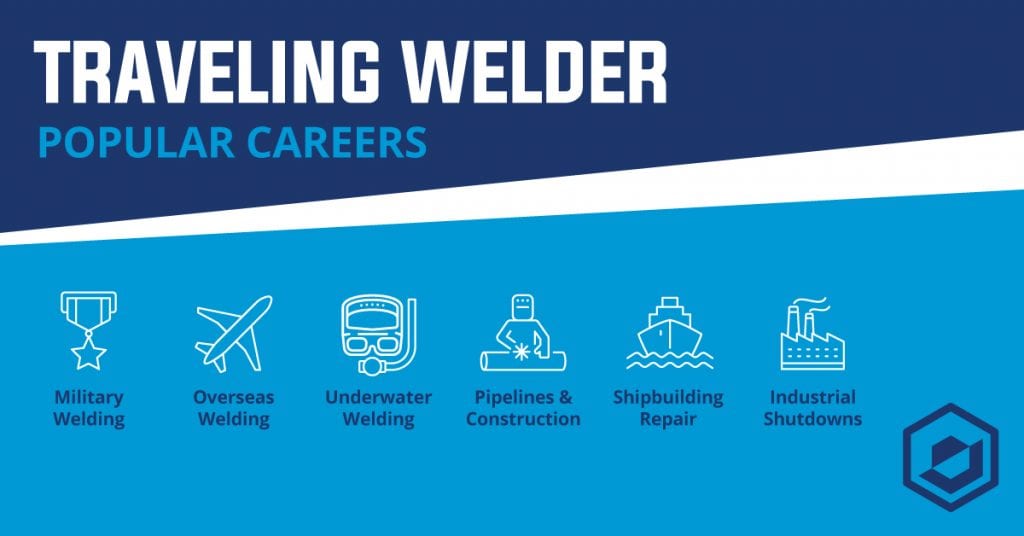
- Traveling welding jobs: shipbuilding and repair, pipeline installation, motorsports, underwater welding and industrial shutdowns
- Welder: employment opportunities include pipefitter, boilermaker and structural welder
What are the Education Requirements for Welding?
Entering the welding profession requires learning a specific skillset. Possessing natural qualities and traits can also prove helpful. Many employers prefer to hire job candidates with formal welding training, and some even pay for the instruction and testing necessary for welder certification.
How to Become a Certified Welder
There are multiple paths to becoming a certified welder: some of the most common are:
- receiving welding training at a vocational school and becoming certified in specific welding processes
- taking a welder qualification test to demonstrate proficiency in certain processes through an employer
- validating a skillset through a test administered by an outside organization, such as the American Welding Society (AWS), the American Petroleum Institute (API) or the American Society of Mechanical Engineers (ASME).
Licensing and Certification Requirements
Welders may need a state occupational license or certification from a national organization in order to work within the state. Requirements vary by state and employer.
MTI offers certifications for students of its welding program in several welding positions and processes, including those necessary for shielded metal arc welding (SMAW), gas tungsten arc welding (GTAW) and flux-cored arc welding (FCAW). MTI’s welding certifications can help validate your skills to potential employers.
Learn more about How Long it Takes to Become a Welder?
What Professions are Similar to Welding?
Curious about professions similar to welding? Consider a career as a pipefitter. While similar, these two careers are distinct in their individual responsibilities.
Pipefitters install pipes and fittings that carry water, gas and other fluids and substances. They tend to work in factories, homes and businesses, and often experience physically demanding jobs. During their duties, they may need knowledge of the welding processes to ensure systems are installed correctly.
Additional occupations similar to welding include:
- Assemblers and Fabricators
- Boilermakers
- Industrial Machinery Mechanics
- Industrial Machinery Maintenance Workers
- Millwrights
- Jewelers and Precious Stone and Metal Workers
- Machinists and Tool and Die Makers
- Metal and Plastic Machine Workers
- Plumbers, Pipefitters and Steamfitters
- Sheet Metal Workers
Explore Welding Programs at MTI
Ready to take the first step toward a welding career?
Midwest Technical Institute’s accelerated Welding Training Program provides hands-on training you can finish in less than a year.
To learn more, contact MTI’s Admissions Team or schedule a tour of your local campus today.
SOURCES
- https://www.hollyfab.com/why-welding-is-vital-to-manufacturing
- https://www.bls.gov/ooh/construction-and-extraction/structural-iron-and-steel-workers.htm#tab-6
- https://www.bls.gov/ooh/construction-and-extraction/plumbers-pipefitters-and-steamfitters.htm#tab-6
- https://weldingworkforcedata.com/
- https://www.bls.gov/ooh/production/welders-cutters-solderers-and-brazers.htm#tab-3
- https://www.bls.gov/ooh/construction-and-extraction/plumbers-pipefitters-and-steamfitters.htm#tab-3
- https://www.bls.gov/ooh/construction-and-extraction/structural-iron-and-steel-workers.htm#tab-3
- https://www.onetonline.org/link/localtrends/51-4121.00?st=IL
- https://www.onetonline.org/link/localtrends/51-4121.00?st=MO
- https://www.aws.org/certification-and-education/professional-certification/#:~:text=Earning%20a%20specialized%20welding%20certification%20can%20reward%20you%20with%20higher%20salary%20potential
- https://data.bls.gov/oesprofile/
- https://www.bls.gov/ooh/production/welders-cutters-solderers-and-brazers.htm#:~:text=Courses%20in%20blueprint%20reading%2C%20shop%20mathematics%2C%20and%20mechanical%20drawing%20may%20be%20helpful.%20An%20understanding%20of%20electricity%20also%20is%20useful.
- https://gowelding.org/articles/green-collar-jobs/
- https://gowelding.org/articles/facts-about-career-welding/
- https://www.bls.gov/ooh/production/welders-cutters-solderers-and-brazers.htm#tab-8